Hey! 👋 Welcome to our PLM Bootcamp informational page! 🎉
This is the only place where you’ll find details about our unique Bootcamp—100% designed to meet the needs of anyone interested in learning PLM real fast (in 9 weeks). Whether you’re looking to level up, bridge the gap between engineering and operations, or finally make sense of how PLM fits into the bigger picture, this Bootcamp is for you.
So let’s deep dive into it, shall we?
Key points
- How we work— and why we're the right choice to teach you.
- Meet your mentors —they’re well known, respected PLM authorities.
- Bootcamp mechanics: How It Works & Why It’s Effective
- Course structure —what you’ll learn.
- The PLM system you’ll be using to practice
- Prerequisite to join the bootcamp
- A unique certification signed by us and ARAS—a.k.a: your key to industry-recognized expertise
- Price


First off, how we work:
As you know, we are a boutique consulting company specialized in change enablement for PLM implementations.
We focus on people, PLM and design.

Thanks to our vision, companies like Audi, Atlas Copco, Mercedes, Metso Outotec, Salomon, Konecranes, and FLSmidth have partnered with us so we help them embark on their PLM journeys safely (hurray!).










As you know, we are a boutique consulting company specialized in change enablement for PLM implementations.
Our PLM bootcamp has been shaped by this seasoned expertise. We guarantee you it will boost your PLM learning speed tenfold 🚀
Meet your world-class mentors
To make sure we launch a top-notch, high-level bootcamp, we’ve partnered with 6 PLM-world big names. These will be your teachers 👇


Matthias Fohrer — Vicepresident Sales EMEA / ARAS
Matthias Fohrer is a senior sales executive at Aras Corporation, overseeing EMEA sales with a focus on SaaS and PLM. His career includes leadership roles in digital transformation at Porsche, NTT DATA, and T-Systems, where he excelled in scaling innovative solutions. Known for his strategic expertise, Matthias is dedicated to advancing client success through technology.
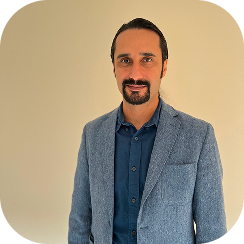
Dr. Yousef Hooshmand — PLM & R&D Toolchain Lead Architect / NIO
Dr. Yousef Hooshmand has more than 15 years of experience in leading transformative PLM initiatives and specializes in developing holistic and federated PLM landscapes that integrate business processes and technological capabilities across the value chain.

Jos Voskuil — PLM Coach, Lecturer and Mediator / TacIT
With over 25 years of global experience, Jos Voskuil has worked with companies, PLM vendors, and systems integrators worldwide. Since 2008, he has shared his insights on PLM through his blog virtualdutchman.com, where he explores the evolving landscape of Product Lifecycle Management.
Jos believes that PLM is not just about technology—it’s also about people, expectations, business value, and methodology. Since 2014, he has focused on supporting companies through their digital PLM transformations, helping them move from coordination to connection, and advocating for a model-based, data-driven infrastructure.

Jim van Oss — Senior PLM Strategist / Fyes
Jim van Oss brings over 15 years of engineering experience and a strong background in managing IT for engineering environments. He spent 4 years leading the implementation of iMan PDM (now Teamcenter), driving initiatives such as putting engineering drawings online and standardizing CAD/CAM/CAE tools.
As a CIO for 13 years, Jim led enterprise-wide initiatives focused on standardization, integrating ERP systems, and enhancing productivity, communication, and overall business efficiency. For the past 8 years, he has overseen the re-implementation of Teamcenter, executing a new strategic vision and managing a team of 80 people to deliver a successful rollout to approximately 6,000 users.

Antonio Casaschi — Director and Global Head of PLM / Assa Abloy
Antonio has been involved in Digital Transformation initiatives for his whole working career, in the Automotive, Energy, and now Security industries. At the beginning of his career, Antonio thought that the challenge was to deliver stable and performing technology. Over time, he learned the hard way that this was not the case.

Beatriz González — Our CEO / Share PLM
Beatriz González is the CEO and co-founder of Share PLM, stepping into the role of CEO in September 2024. With a background in aeronautical engineering, she brings a technical and strategic perspective to PLM and change management. Beatriz has been instrumental in shaping Share PLM’s approach to people-centric digital transformations, ensuring that organizations successfully bridge the gap between technology, processes, and people. Passionate about innovation and transformation, she continues to lead the company in delivering impactful solutions for businesses worldwide.


About this New and Practical PLM Bootcamp. This is how it works:
Starts
Next 2026
Ends
Format
9 consecutive weeks online intensive training.
End of Registration Period
On 8th of January.
As a student, you'll attend an online session every week. Each session lasts around 90 minutes, adding up to 12 hours of training. Throughout the course, you'll gain rare and eye-opening insights into PLM that few people ever acquire.
Sounds fair? Good!
Second, you’ll get access to an intuitive Learning Management System (LMS), where you can join live sessions, review all course materials, and complete your hands-on exercises — all in one place.
No need to download or purchase anything extra. 😊
Third, this PLM Bootcamp merges
mandatory knowledge on:
- PLM as a framework (not just as a system).
- The different systems options out there.
- And the processes.
With → a real-scenario simulation where you, along with other students, will develop a drone (yes a drone). To do this task, week by week, you’ll take on different roles during each session. (First you’ll act as a sales rep maybe… then as a Program Manager, Project Manager, Designer, Concept Architect, Manufacturing Engineer…). This simulation will broaden your perspective.

You’ll put yourself in the shoes of other departments. That will allow you to understand their struggles, which in turn will show you how to best collaborate with other professionals in any company (minimizing avoidable mistakes and speeding up processes).
From design, to manufacturing, development and service you’ll get a grip on Product Lifecycle stages you didn’t have before.
PLM Bootcamp’s Structure: What you’ll learn
Before I show you the curriculum allow me to tell you a brief anecdote
that may resonate with you 👇
On June 05 we started developing this bootcamp. And to make sure it was great, we led a Discovery Phase. We interviewed 37 people. Some of them were advanced PLM consultants. Others were PLM architects.
Others were managers, developers and more.
Regardless of their role, most of them told us they were interested in learning about:
- PLM integrations.
- PLM as a framework, not just as a system.
- PLM processes, strategies and concepts.
Aaaand trends in PLM.
All because they felt like they:
- Lacked overview knowledge on different phases within PLM.
- Had serious difficulties understanding Change Management.
- Lacked knowledge on different systems integrations and when to do them.
And had no real clue about PLM nukes and crannies because they had learnt PLM on the fly (after onboarding on their jobs) and they wanted to enhance their strategic approach to PLM.
Do you also feel like them? Can you confidently say you have PLM expertise?
Or are you losing opportunities because of that?
Maybe money? Clients? Better jobs?
If so, good news! In order to satisfy those needs (and more) we developed this carefully planned curriculum:
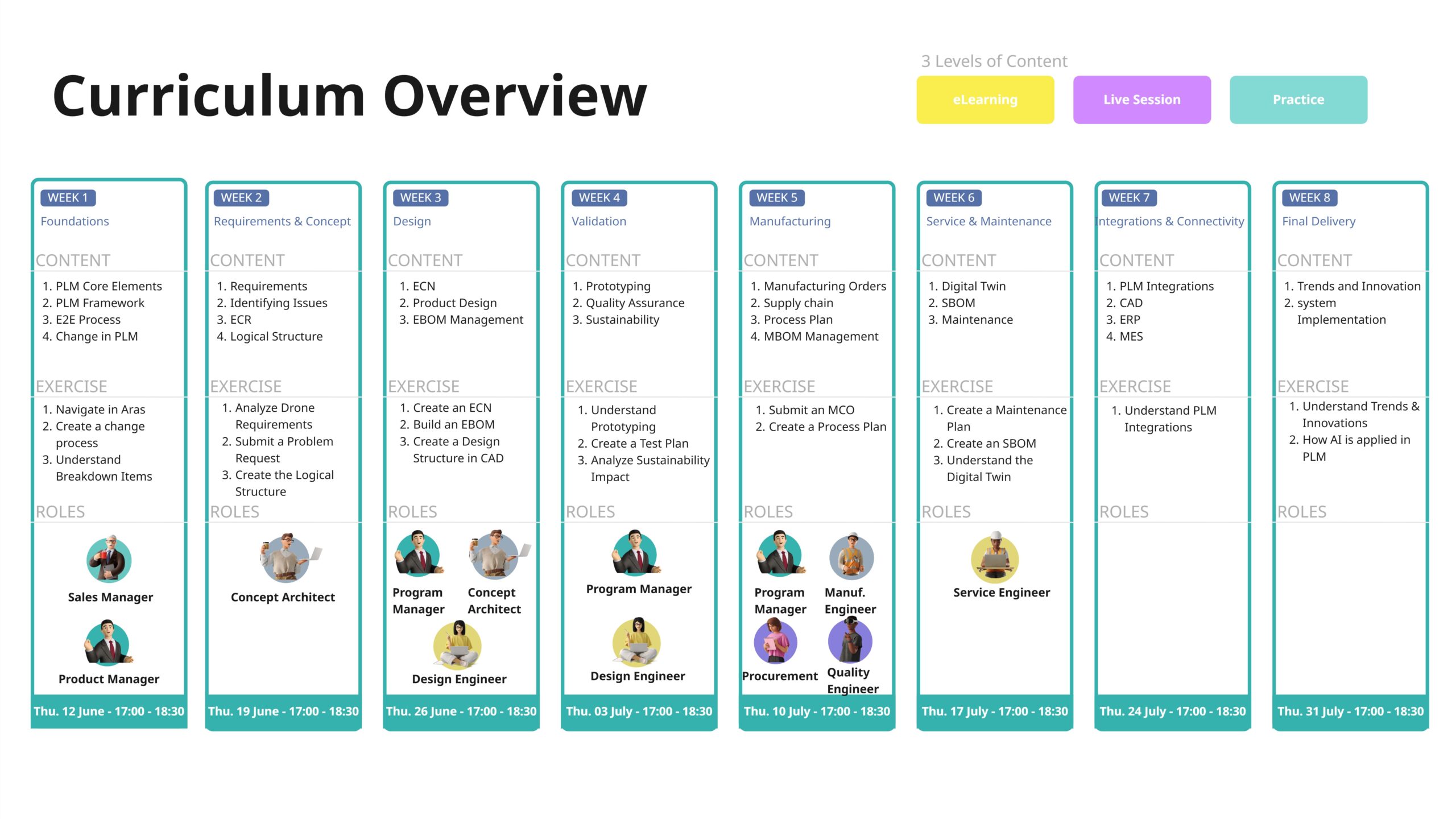
What you’ll learn, explained.
On Week 1, to kick-off the Bootcamp, you’ll learn:
Week 1: The Foundations
In the first week, learners are introduced to the key concepts of Product Lifecycle Management (PLM). The content includes:
Lesson 1: Core elements of PLM and its strategic value.
Lesson 2: Structure of the PLM framework and its integration in the organisation
Lesson 3: Understanding the full end-to-end process.
Lesson 4: Managing change within a PLM system.
This week lays the foundation for deeper exploration in the following modules.
Week 2: Requirements and Concept
This week focuses on capturing and structuring product requirements and early design concepts. The lessons include:
Lesson 1: How to define clear and actionable product requirements.
Lesson 2: Identifying, documenting, and reporting issues effectively.
Lesson 3: Proposing product improvements using Engineering Change Requests (ECR).
Lesson 4: Defining the logical structure of the product in early development stages.
These topics support a strong foundation for planning and decision-making in the PLM process
Week 3: Design
This week focuses on turning product concepts into structured, manageable designs.
The lessons include:
Lesson 1: Implementing approved changes through Engineering Change Notices (ECN).
Lesson 2: Developing and refining the product design to meet requirements.
Lesson 3: Defining and managing the Engineering Bill of Materials (EBOM) to ensure product integrity.
These activities are essential to move from planning to tangible product development.
Week 4: Validation
This week focuses on validating the product design to ensure it meets quality, performance, and sustainability standards.
The lessons include:
Lesson 1: Prototyping a new product to test design assumptions and functionality.
Lesson 2: Applying quality assurance practices to minimise errors and ensure compliance.
Lesson 3: Integrating sustainability principles into product development decisions.
These topics help ensure that the final product is reliable, high quality, and environmentally responsible.
Week 5: Manufacturing
This week focuses on preparing the product for production, addressing manufacturing needs and planning. The lessons include:
Lesson 1: Managing Manufacturing Change Orders (MCOs) to implement production updates.
Lesson 2: Understanding the role of the supply chain in PLM and ensuring smooth material flow.
Lesson 3: Creating a process plan to guide manufacturing operations.
Lesson 4: Managing the Manufacturing Bill of Materials (MBOM) for accurate production.
This stage ensures that the product design is efficiently and effectively transferred to manufacturing.
Week 6: Service and Maintenance
This week explores how PLM supports product performance after launch through service and maintenance strategies. The lessons include:
Lesson 1: Understanding the concept of the Digital Twin and its role in monitoring product use.
Lesson 2: Introduction to the Service Bill of Materials (SBOM) and its function in service planning.
Lesson 3: Approaches to effective product maintenance and lifecycle extension.
This module highlights the importance of long-term support in the product lifecycle.
Week 7:
This final week explores how PLM connects with other key business systems to ensure data consistency and process efficiency. The lessons include:
Lesson 1: Overview of PLM integrations and their value in digital continuity.
Lesson 2: How PLM integrates with CAD systems to manage design data.
Lesson 3: The connection between PLM and ERP for enterprise-wide coordination.
Lesson 4: Integrating PLM with MES to support manufacturing execution.
This week highlights the importance of a connected digital ecosystem in the product lifecycle.
Week 8: Final Delivery
In the final week, the focus shifts to future perspectives and real-world applications of PLM. The lessons include:
Lesson 1: Exploring current trends and innovations shaping the future of PLM.
Lesson 2: Best practices and considerations for successful PLM system implementations.
Knowledge Check: A final assessment to review and reinforce key concepts learned throughout the course.
This concluding module prepares learners to apply their knowledge and stay updated in a rapidly evolving PLM environment.
At the end, to reward your efforts you’ll receive a certificate 👏🎉 like this one:

Since there are no dedicated university degrees in PLM, there’s nothing you can showcase on LinkedIn (or other platforms) that proves you know PLM. This certificate will grant you another weapon in your CV arsenal to knock out of balance even the most strict HR tough cookies.
You will get certified in Demonstrating PLM Skills and Knowledge with a certification signed by Share PLM and ARAS upon completing the PLM Bootcamp.
And you’ll be able to back up your PLM expertise anytime.
The PLM system you’ll be using to practice: ARAS Innovator
To accomplish all your PLM tasks you won’t be using ENOVIA, Teamcenter, PTC Windchill nor Autodesk. All students will use ARAS Innovator.
We chose Aras because it’s flexible, modern, and widely used in real-world PLM implementations.
- It lets us show real PLM processes, not just theory.
- Its intuitive web-based interface is great for hands-on learning.
- It’s powerful to simulate real scenarios, like managing the lifecycle of a drone.
With Aras, participants get to experience PLM the way companies actually use it.
Plus, some of our advisors for the Bootcamp are from Aras, which means expert support is just a question away!
Prerequisite
If you join this bootcamp, shortly after, you’ll receive an email with the link to a course. You’ll have to go through it before joining the Bootcamp.
This Rise Course serves to ensure you have the basic PLM knowledge to benefit from the training. But don’t worry. It’s self-paced so it can take up to 2 weeks, or an intense afternoon. You’ve got this!
Complete it before the bootcamp starts.
If you don’t do it, you may feel lost during the camp. Don’t risk it.
PRICE
The price to attend the bootcamp is
€1990
Other bootcamps charge from € 2,000 to € 6,000+
We are in the budget friendly range as it is our first cohort and we do not have reviews yet.
When we do, we’ll charge way more for this bootcamp.
As it’s unique in his kind.
Any doubts left?
- Afraid you won’t have the time?
- Worried this bootcamp is not for you?
- Would you like to explore finance options?
Book a call with us! Our Customer Service Specialist, José M. Rosendo, will mark your number and make your smartphone (or iPhone) ring! You will be able to clarify any doubts and make an informed investment in a quick, warm, no-strings-attached call.
Whether you are interested in joining our PLM Bootcamp or still on the fence…
Remember inscriptions are only available until 23rd of May.
If you want to take action do it before that date.
Otherwise, you’ll miss this opportunity at its lowest price.
